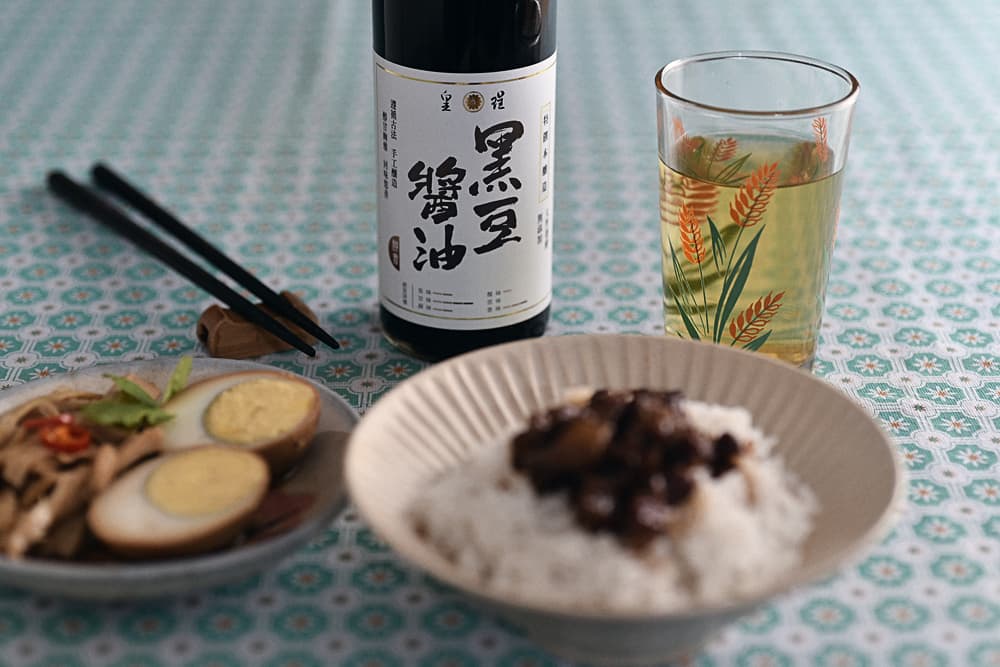
1. Brand and products
Royal Jade is a soy sauce brand from Pingtung, Taiwan. Built on the character of Taiwan-grown grains, it follows a “subtractive” approach with aseptic handling, and brews and ages its soy sauce for 6 months to 3 years.
Royal Jade makes 8 soy sauces: Koikuchi, Usukuchi, Tamari, Saishikomi, Shiro, Black Soybean, Genzui and Shinen, with salinity of about 10% to 16%. See the product pages for sizes and prices.
They differ in ingredients, salinity and brewing time:
| Variety | Ingredients | Salinity | Brewing time | Flavor and character |
|---|
| Koikuchi | Soybeans, wheat, sugar | 13% | 1 year | All-purpose; the classic soybean-and-wheat taste, balancing all five flavors. |
| Usukuchi | Soybeans, wheat, fragrant rice | 14% | 8 months | Gentle and savory; supports the food without overpowering it. |
| Tamari | Soybeans, fragrant rice | 16% | 1.5 years | Rich and deep; suits hearty dishes. |
| Saishikomi | Soybeans, wheat | 12% | 2 years or more | Double-brewed, with twice the ingredients brewed a second time. |
| Shiro | Wheat, soybeans | 12% | 6 months | Clear rather than dark; keeps the natural color of the food. |
| Black Soybean | Black soybeans, sugar | 12% (meets the reduced-salt standard) | 1 year | The old-fashioned taste of Taiwan: rich bean aroma and a mellow sweetness. Good for braising and red-braising, and for dressing and dipping. |
| Genzui | Black soybeans | 16% | 1.5 years | Dry-brewed, salt-sealed black soybean hudi-you, with no added sweetness. |
| Shinen | Black soybeans | 10% | 2 years or more | Double-brewed, with twice the black soybeans brewed a second time. |
Based on each variety’s cooking suggestions:
| Cooking method | Recommended Royal Jade soy sauce |
|---|
| Pan-frying, simmering, stir-frying | Koikuchi, Usukuchi, Black Soybean, Genzui |
| Dressing, dipping | Koikuchi, Usukuchi, Black Soybean, Genzui, Shiro |
| Steaming | Usukuchi, Shiro, Genzui |
| Slow braising | Koikuchi, Tamari, Saishikomi, Shinen |
| Glazing, stewing, roasting | Tamari, Saishikomi, Shinen |
| Marinating, lu-style braising, red-braising | Tamari, Black Soybean, Saishikomi, Shinen |
We will be adding a series of cooking ideas with more detailed suggestions soon.
2. Ordering, payment and after-sales
You need to register and sign in before buying; when you register, we email you a verification code to confirm your address.
- Once signed in, choose your soy sauces and add them to your cart.
- Fill in your delivery details and send your order.
- Pay by credit card or ATM virtual account.
- We confirm payment automatically and ship once it succeeds.
Yes.
- How to sign in: Press “Sign in with LINE” on the member sign-in page, or “Sign up with LINE” on the sign-up page, and approve the request in LINE. When you sign up with LINE for the first time, you need to tick the box agreeing to the Terms of Service and Privacy Policy. Members who signed up with email can link LINE on the “Edit profile” page and then use either way to sign in. The first time you use LINE sign-in, LINE asks you to enter a verification code shown on screen in the LINE app on your phone.
- Before your first order: A LINE account has no email address, so before your first order you need to add and verify an email address (order notifications are sent there).
- iPhone confirmation code: A note for iPhone users: after you approve in LINE, the result is sent to your phone’s default browser. If the browser where you started signing in (for example Safari) is different from your default browser (for example Chrome), the default browser shows a 6-digit confirmation code. Go back to the original browser, open the member sign-in page, and enter the code below the “Sign in with LINE” button (valid for 10 minutes) to finish signing in. If the browser where you started is your default browser, no code is needed.
For orders under 6 bottles, the shipping fee is shown in your cart and at checkout; you choose how to pay after you send the order.
- Shipping fee: orders of 6 or more bottles ship free (mainland Taiwan, non-remote areas only); shipping to outlying islands and remote areas is charged separately and we will contact you.
- Payment: credit card or ATM virtual account (ECPay’s payment page); after sending the order, choose on the confirmation page or in My orders. Payment is confirmed automatically, so there is nothing to report.
- Unpaid orders: If payment is not completed within 3 days of placing the order, the order is cancelled automatically and the stock is released (if you have an ATM virtual account, after its payment deadline passes). If you still want the items, please place a new order.
- Dispatch: we ship once payment succeeds, and the tracking number then appears on the same page.
- Delivery window: at checkout you can choose any time, before noon, or 1:00–5:00 pm.
No. Your card number is entered only on ECPay’s payment page and never passes through the Royal Jade website, and we will never ask for your card number, password or verification code by phone, text message or email. If you receive such a request, do not give out any information, and call or email us directly to check.
Items in stock ship within 3 to 5 business days after we confirm payment. We deliver with Kerry TJ Logistics, and delivery usually takes 3 to 5 business days after dispatch (mainland Taiwan, non-remote areas).
- Outlying islands and remote areas: delivery takes longer; the carrier will let you know. Shipping to outlying islands and remote areas such as Penghu, Kinmen and Matsu is charged at the carrier’s rates. We will tell you the actual fee after you order and ship only once you agree; if you don’t agree, you can cancel for a full refund.
- If we can’t ship on time: every product is naturally brewed and ferments for 6 months to 3 years, so if we cannot ship on schedule, we will email you the new expected shipping date. If shipping is delayed by more than 14 days beyond the expected date, you can cancel for a full refund, which we file within 15 days.
If an item is out of stock, we will email you as soon as we receive your order. You can choose to:
- Change your order: switch to another variety.
- Wait for restock: we ship once the item is available again.
- Cancel the order: we give a full refund and file it within 15 days.
If an out-of-stock item leaves your order below 6 bottles, you can add other items to make up the difference, or wait and have everything shipped together once the item is back in stock.
You can request a return or exchange within 7 days of receiving your order (weekends and holidays included). Contact us within the 7 days and, once we confirm, send the goods back as instructed. The 7 days are a cooling-off period, not a trial period.
- Can be returned or exchanged: brand-new, unopened items in intact packaging (including a change of mind), wrong items sent, and quality problems with unopened items; we pay the return shipping. Sediment in soy sauce is normal and is not a quality defect.
- Cannot be returned or exchanged: items whose cap seal has been opened, whose packaging is damaged, or that show signs of use, for food safety and hygiene reasons.
- Damaged or leaking cartons: please check the outer carton when you sign for the parcel. If it is damaged, wet or leaking, refuse delivery and tell us the same day; we will send a replacement and handle the claim with the carrier. Royal Jade is naturally brewed soy sauce with no additives, so leaked sauce can quickly mold and smell in Taiwan’s hot, humid climate and affect the whole carton; please let us know as soon as possible.
- Packing a return: please pack the items firmly with bubble wrap or similar protection, and include the original packaging and any free gifts. If items break on the way back because of poor packing, we will contact you to agree on how to handle it.
- Refunds: we file your refund within 15 days after we receive the returned goods. If you paid by bank transfer, the refund goes to the orderer’s own account and we cover the transfer fee. After a return or refund, we will issue an invoice allowance or void the invoice as required.
- Returns from free-shipping orders: if part of a free-shipping order (6 or more bottles) is returned within 7 days for a reason other than quality, such as a change of mind, and fewer than 6 bottles remain, we charge the order’s shipping fee. This does not apply to returns due to quality defects, wrong items or damage in transit.
- Returned parcels: if a parcel comes back because of incorrect delivery details or because no one was there to receive it, the orderer pays the shipping both ways.
See the Return policy page for full details.
Yes. Before you pay, sign in, open My orders and select the order. You can:
- Change quantities (set to 0 to remove an item; at least 1 item must remain, and new items cannot be added)
- Change your delivery details, delivery window and note
- Cancel the order
Once an order has entered the payment process it cannot be edited for the time being (cancel it and order again if you need changes); orders that have been paid or shipped cannot be changed online either, so please contact us (details in the footer).
Yes. A subscription buys the same products and quantities in every delivery.
- Cycle: delivered every month, every 2 months or every quarter, for 3, 6 or 12 deliveries.
- Payment options: prepay all deliveries for 5% off with free shipping on every delivery, or pay per delivery at the regular price plus shipping each time.
- Reporting payment: payment works like a regular order, by bank transfer. After transferring, sign in, open Look up subscription, and report the last five digits of your account.
- Dispatch: once we confirm payment, we reserve your place and schedule each delivery. The first delivery is expected to ship about 7 days later, and the rest follow your chosen cycle (dates are estimates and may change with production). If you pay per delivery, from the second delivery on we will let you know before each one that payment is due.
Products and places available for subscription are limited; please check the subscription page. To cancel a subscription, please contact us (details in the footer).
3. Types of soy sauce and brewing
Brewed soy sauce is made by growing koji on beans (sometimes with grains) and fermenting it for a long time. Hydrolyzed soy sauce breaks down plant protein with acid and is done in a few days. Semi-brewed soy sauce adds hydrolyzed liquid to the moromi (fermenting mash), which is then fermented and matured further. Blended soy sauce is a mix of two or more soy sauces. Since 2019, all packaged soy sauce in Taiwan must state its production method on the label; see Q19 for details.
The main differences are the ingredients and the flavor:
- Black soybean soy sauce (yin-you): brewed from black soybeans, usually without wheat. It has a stronger aroma and a rich body, the old-fashioned taste of Taiwan, and is especially common in Changhua, Yunlin, Chiayi and Tainan.
- Yellow soybean soy sauce (soybean and wheat): brewed from soybeans and wheat, the most common method worldwide. It originated in China and was refined in Japan. Its aroma is bright with a hint of richness; a splash down the side of a hot wok brings out the aroma of the food.
Most Taiwanese households know soybean-and-wheat soy sauce best; if you want the rich, old-fashioned taste, try black soybean soy sauce.
Wheat provides starch, which feeds the koji mold. It makes fermentation more vigorous and is turned into sugars and aromas, giving the soy sauce a rounder flavor.
These are common Taiwanese names for soy sauce; they differ in how they are made and used:
- Yin-you: usually soy sauce brewed from black soybeans. “Yin” refers to the step after the koji is made and washed, when it is wrapped in cloth and left covered to heat up a second time. Because it is dry-fermented, black soybean soy sauce has a stronger aroma.
- Hudi-you: the undiluted soy sauce drawn from the bottom of the vat when brewing black soybean soy sauce, with the richest flavor. Many products on the market today are diluted with water, so to judge quality you can ask the maker about the concentration of the original liquid.
- Bai dou-you (white soy sauce): light in color, for dishes where you want to keep the natural color of the food.
- Soy paste: soy sauce thickened with glutinous rice or corn starch; most products today use modified starch.
Note: The explanation of “yin” comes from Sekine Kazuo (1995), 「台湾における醤油の現状」 (The current state of soy sauce in Taiwan), Journal of the Brewing Society of Japan, 90(5), 350–355.
It depends on the ingredients and the method:
- Royal Jade: brewed and aged for 6 months to 3 years, for example Shiro 6 months, Usukuchi 8 months, Koikuchi 1 year, and Tamari and Genzui 1.5 years. Saishikomi and Shinen are double-brewed with twice the ingredients, and both are brewed for more than two years. Each is released only once its flavor and aroma meet our standard.
- Typical naturally brewed soy sauce: usually about 4 to 6 months.
- Hydrolyzed (chemical) soy sauce: only a few days. Defatted soybeans are broken down with hydrochloric acid and then neutralized with an alkali such as baking soda. The fat in the soybeans must be removed as far as possible, because leftover fat reacts with the acid to form 3-MCPD (3-monochloropropane-1,2-diol), a possible carcinogen.
The longer the brewing, the more fully the soybean protein breaks down, and the more layered the flavor and aroma.
They differ in how they are made, their color and their use:
- Light soy sauce (sheng chou): lighter in color and savory, mostly for seasoning and dipping. Traditionally it is the unheated liquid pressed straight from the moromi, keeping its original savory flavor. To meet food hygiene standards and to keep and distribute well, most light soy sauce today is heat-sterilized, so its flavor differs slightly from the traditional raw liquid.
- Dark soy sauce (lao chou): dark and thicker, mainly for adding color to dishes such as red-braised pork. Traditionally, sugar is cooked until caramelized, simmered with light soy sauce, and returned to jars in the sun for months or even years so the water slowly evaporates, making the sauce thicker and darker. Because this takes so long, most dark soy sauce today is colored with caramel color for a steady supply; check the ingredient list when buying.
- Light-colored (white) soy sauce: golden in color, for dishes such as chawanmushi (steamed egg custard) and clear soups where you want to keep the color of the food.
4. Labels, regulations and choosing
First check the production method on the package. By law, packaged soy sauce must state one of these four methods:
- Brewed: made by growing koji on beans (and grains) and fermenting it; hydrolyzed soy sauce may not be mixed in.
- Products labeled “brewed” or “pure brewed” must contain at least 0.8 g of total nitrogen per 100 ml, or at least 0.5 g for black soybean soy sauce.
- The “brewed” label is voluntary, so some brewed soy sauces do not use it, but any product that does must meet the standard. To be sure of a brewed soy sauce with enough substance, choose one that is clearly labeled.
- Hydrolyzed: not fermented; the protein in soybean meal (high-protein soy flakes) is broken down with hydrochloric acid or enzymes.
- Enzymes cost more and work more slowly, so hydrochloric acid is used most.
- Soybean meal is used instead of whole soybeans because any leftover soybean fat reacts with the acid to form 3-MCPD.
- Some hydrolyzed soy sauces use preservatives; check the ingredient list if you want to know.
- Semi-brewed: the amino acid liquid from hydrolysis is added to the moromi of brewed soy sauce and fermented and matured together. This raises the concentration and softens the harsh smell of the hydrolyzed liquid. Such products are uncommon in Taiwan today.
- Blended: a mix of two or more soy sauces, such as brewed soy sauce with hydrolyzed soy sauce added. Any product containing hydrolyzed soy sauce must be labeled “blended soy sauce.”
Next, check the ingredient list: words such as “acid-hydrolyzed soy protein” or “acid-hydrolyzed amino acid liquid” usually mean hydrolyzed, semi-brewed or blended soy sauce.
A reminder: “naturally brewed” and “additive-free” are not the same. Naturally brewed means no hydrolyzed soy sauce is mixed in; whether flavor enhancers or other food additives are used is shown separately in the ingredient list.
These are quality measures that Taiwan’s national standard CNS 423 uses to grade soy sauce; higher numbers usually mean a richer soy sauce:
- Total nitrogen: reflects the protein content from soybeans and wheat.
- Amino nitrogen: reflects how far the protein has broken down into savory amino acids.
- Salt-free soluble solids: the amino acids, sugars, organic acids and other substances dissolved in the soy sauce, excluding salt; it shows how much substance the soy sauce has.
CNS 423 sets different standards by ingredient and type:
- General soy sauce: soy sauce made from soybeans, wheat and similar ingredients; anything that is not black soybean soy sauce falls here.
- Black soybean soy sauce: made by the traditional brewing method with koji grown on black soybeans alone. If wheat, rice or other grains are added, it falls under the general soy sauce standard.
- Soy paste: soy sauce with a thickener added so that its viscosity at 25°C is at least 250 cps. CNS also classes yin-you and hudi-you here.
- Light-colored soy sauce: soy sauce with a light color: a color value (Abs 555 nm) of 3.0 or less, or standard color 19 or above.
- Reduced-salt soy sauce: whatever the ingredients, any product that claims “reduced salt” must meet this standard: no more than 12 g of salt (NaCl) per 100 ml, and no preservatives.
| Type | Grade | Total nitrogen (g/100ml) | Amino nitrogen (g/100ml) | Salt-free soluble solids (g/100ml) |
|---|
| General soy sauce | A | ≥ 1.4 | ≥ 0.56 | ≥ 13 |
| General soy sauce | B | ≥ 1.1 | ≥ 0.44 | ≥ 10 |
| General soy sauce | C | ≥ 0.8 | ≥ 0.32 | ≥ 7 |
| Black soybean soy sauce | A | ≥ 1.2 | ≥ 0.48 | ≥ 12 |
| Black soybean soy sauce | B | ≥ 0.8 | ≥ 0.32 | ≥ 11 |
| Black soybean soy sauce | C | ≥ 0.5 | ≥ 0.2 | ≥ 7 |
| Soy paste | A | ≥ 1.2 | ≥ 0.48 | Not specified |
| Soy paste | B | ≥ 0.9 | ≥ 0.36 | Not specified |
| Soy paste | C | ≥ 0.6 | ≥ 0.24 | Not specified |
| Light-colored soy sauce | Ungraded | ≥ 1.1 | ≥ 0.44 | Not specified |
| Reduced-salt soy sauce | Ungraded | ≥ 1.1 | ≥ 0.44 | Not specified |
The baseline for naturally brewed soy sauce is Grade C: Taiwan’s Ministry of Health and Welfare requires soy sauce labeled “brewed” to contain at least 0.8 g of total nitrogen per 100 ml (0.5 g for black soybean soy sauce), exactly the Grade C total nitrogen for general and black soybean soy sauce under CNS. In other words, Grade C is the minimum for naturally brewed soy sauce and Grade A is the highest. Because the ingredients differ, figures for black soybean soy sauce cannot be compared directly with general soy sauce.
Other rules:
- Levulinic acid: brewed soy sauce may contain no more than 0.1% levulinic acid (0.01% for light-colored and reduced-salt soy sauce). Levulinic acid is an indicator of whether a soy sauce is naturally brewed.
- Grade and name on the label: graded products should state their grade (A, B or C); soy sauce made by the traditional brewing method may be labeled “naturally brewed soy sauce”; soy sauce brewed from black soybeans should be labeled “black soybean soy sauce.”
Source: Bureau of Standards, Metrology and Inspection, CNS 423 Soy Sauce (revised August 7, 2002; reaffirmed October 2013).
We don’t recommend relying on these alone; Taiwan’s Consumers’ Foundation also describes them as outdated. Here’s why:
- Foam: whether shaking produces a fine foam depends mostly on how the soy sauce is heated at the end. When it is cooked at 90°C or above, the structure of its proteins and amino acids changes and it foams easily. Taiwanese black soybean soy sauce usually puts more emphasis on simmering, so it foams easily. Soybean-and-wheat soy sauce produces alcohol during fermentation; to keep that aroma, some makers use special steamers to limit alcohol loss, or keep the temperature below its evaporation point, so a naturally brewed soy sauce may not foam much either. Amino acids from hydrolysis also foam, so foam is not a reliable sign.
- Color: the amino acids and reducing sugars in soy sauce go through the Maillard reaction more strongly the longer and hotter it is cooked, which darkens the color. So the shade has no fixed link with whether it is naturally brewed.
- Price: price depends on packaging, sales channel, brand and many other factors, and is not enough to judge quality.
The most reliable way is still to check the production method, the ingredient list and the concentration (total nitrogen), and to make sure the maker has a food business registration number.
The bottle material has nothing to do with how the soy sauce is made and cannot tell you its quality or whether it has additives, but it does affect shelf life before opening; glass bottles usually keep longer. The main differences are in filling and sterilization:
- Glass bottles: usually heat-sterilized again after bottling.
- Plastic bottles: good naturally brewed soy sauces also come in plastic. If a soy sauce in a plastic bottle has no preservatives, the maker usually uses aseptic cold filling or a similar technique, bottling in a clean environment.
When choosing, look at the production method and the ingredient list rather than the bottle.
No Royal Jade soy sauce uses food additives; the ingredients are simple. Here is how the terms you see on the market differ:
- Naturally brewed: made entirely by fermentation, with no hydrolyzed soy sauce mixed in. However, naturally brewed soy sauce may still legally use food additives, so “naturally brewed” does not mean “additive-free.”
- Pure soybean brewed: goes a step further, meaning it is brewed only from beans, without wheat, rice or other grains.
- Additive-free: usually means no preservatives, caramel color, sweeteners and so on, but each brand defines it differently, so the ingredient list is what counts.
Did you know: yeast extract is not classed as a food additive. It has no food additive permit number and is covered by separate rules. Yeast extracts vary by brand; methods published in some makers’ patent filings show that flavor substances such as disodium 5′-guanylate and disodium 5′-inosinate are added during production, so it is not simply something extracted from yeast. Since soy sauce makers mostly buy yeast extract from suppliers and the ingredient list only says “yeast extract,” the makers may not know every detail of how it is produced. If this matters to you, ask the maker where its ingredients come from.
5. Storage and shelf life
We recommend keeping it in the refrigerator after opening. Unopened, it can be stored at room temperature in a cool place; once opened, soy sauce is exposed to air and oxidizes, and its color, aroma and taste slowly decline. Soy sauce without preservatives or with less salt molds more easily in Taiwan’s hot, humid climate. Royal Jade soy sauce contains no preservatives, so please always refrigerate it after opening.
Please follow the best-before date on the bottle.
- Unopened: all Royal Jade products keep for two years unopened. When your order arrives, please check the bottles and their contents within 7 days; if anything seems wrong, contact us and we will handle it under our return policy.
- After opening: keep it in the refrigerator. For the best flavor, we recommend using it within about 1 month of opening, though this depends on how it is stored. If you don’t use much, we suggest the smaller bottle.
We don’t recommend it. Soy sauce is salty, sterilized and contains alcohol from fermentation, so it does not spoil easily; but past its best-before date its quality can no longer be guaranteed, so for your health please don’t use it. If an opened bottle smells off, changes color or grows mold, don’t use it even if it is still within date.
Royal Jade soy sauce contains no preservatives, so please refrigerate it after opening. Store it in a cool place, and try not to leave it next to the stove after use, as the heat makes soy sauce spoil faster.
Some soy sauces on the market come in oxidation-proof packaging such as double-layer vacuum bottles, which keep air out after opening, so their labels may say they can be kept at room temperature once opened. Storage differs by product, so please follow each product’s label.
6. Ingredients and additives
No Royal Jade soy sauce uses food additives, so of course none contains preservatives.
Some soy sauces on the market do contain preservatives, commonly benzoic acid, sorbic acid, dehydroacetic acid or parabens. They are legal within the permitted limits, but they must be listed in the ingredients.
Soy sauce’s own makeup also helps preserve it: when the salt concentration is high and plenty of other substances such as amino acids and sugars are dissolved in it, its water activity drops and microbes have a hard time growing. This is one reason soy sauce keeps a long time in intact packaging even without preservatives.
Royal Jade chooses not to use food additives to offer one more option for people who want simple ingredients.
But additives alone do not make a soy sauce good or bad. Each additive has a purpose, such as preserving, coloring, or adding sweetness or savoriness.
Some soy sauces use additives as a carryover from the past: before refrigerators were common, preservatives kept soy sauce from spoiling. Any product whose additives are legal and accurately labeled is safe to eat.
3-MCPD forms when leftover fat reacts with hydrochloric acid while defatted soybeans are hydrolyzed with acid. Naturally brewed soy sauce is fermented with koji mold and never hydrolyzed with hydrochloric acid, so it does not produce 3-MCPD, and the same is true of Royal Jade’s naturally brewed soy sauce. Since 2021, Taiwan has limited 3-MCPD in soy sauce and soy sauce products to 0.3 ppm, stricter than the Codex Alimentarius limit of 0.4 ppm; at normal seasoning amounts it poses no harm.
To suit Taiwanese tastes, Royal Jade’s Koikuchi and Black Soybean soy sauces include cane sugar, but no licorice and no added alcohol. In general, sugar and licorice balance saltiness and add sweetness, which suits the Taiwanese preference for a sweeter taste; alcohol helps inhibit microbes and keep quality stable, and can also form naturally during fermentation.
Caramel color is a legal additive used to darken and even out the color of soy sauce, and it must be listed in the ingredients when used. The color of naturally brewed soy sauce comes mainly from the Maillard reaction during fermentation and aging. Royal Jade soy sauce contains no caramel color; its color comes from brewing, aging and simmering.
No Royal Jade soy sauce or farm product uses genetically modified soybeans. All of Royal Jade’s grains are currently grown by us, and all are Taiwanese varieties. Non-GMO soybeans are soybeans whose genetic traits have not been altered by genetic engineering. In Taiwan, foods that use genetically modified ingredients must say so, so you can check the label.
7. Health and special diets
Royal Jade soy sauces range from about 10% to 16% salt, depending on the variety. Based on general soy sauce figures in hospital health education materials, about 6 ml (about 1.2 teaspoons) contains as much sodium as 1 g of salt; Taiwan’s Ministry of Health and Welfare recommends that adults keep sodium below 2,400 mg a day (about 6 g of salt). Because salinity differs between soy sauces, the most accurate way is to check the sodium content on the nutrition label. We suggest counting soy sauce in your total salt for the day.
Royal Jade soy sauce uses no potassium salt, and our Black Soybean and Shinen soy sauces both meet the salinity standard for reduced-salt soy sauce. Reduced-salt soy sauce has about half the sodium of regular soy sauce, which suits people who need to limit sodium; under Taiwan’s national standard it must be 12% salt or less and contain no preservatives. However, many low-sodium products replace sodium with potassium. If you have chronic kidney disease, are on dialysis, have heart failure, or take certain blood pressure medicines (such as ACE inhibitors, ARBs or potassium-sparing diuretics), too much potassium may be risky; check the ingredients when buying, and ask your doctor or dietitian first.
The allergens Royal Jade soy sauce may contain are soy and wheat:
- Soy: all Royal Jade soy sauces are brewed from yellow or black soybeans, and black soybeans are soybeans too, so please avoid them if you are allergic to soy.
- Wheat (gluten): Royal Jade’s Black Soybean, Genzui and Shinen, and the soybean-brewed Tamari, contain no wheat in their ingredients. However, they are made on the same equipment as products that contain wheat, so if you have celiac disease or a severe gluten allergy, please ask your doctor before using them.
In general, the common allergens in soy sauce are soy and wheat, and by law allergen information must appear on the package, so please check before buying. Soy sauce brewed from soybeans and wheat contains gluten, and related products such as soy paste and oyster sauce often contain wheat starch too. If you are sensitive to gluten, choose products with no wheat in the ingredients at all, rather than relying on a “no gluten detected” test report.
Yes, in moderation. Young children’s kidneys are still developing, so keep their salt low, and we don’t recommend adding soy sauce to food for babies under one year old.
8. Appearance and quality
If they are clear, hard crystals, they are most likely salt left behind as water evaporates from the soy sauce; they are harmless, so just wipe them off. However, soy sauce is rich in amino acids and other nutrients, so microbes grow easily once it is contaminated; if you see fuzzy white patches or small white colonies, it may be mold or bacteria, so please don’t use it.
To be safe, we recommend not using it. If opened soy sauce is left at room temperature, a thin white film, sometimes called “white bloom,” can form on the surface; it is usually salt-tolerant yeast. Such yeast is common while soy sauce ferments, but it gradually disappears once fermentation is complete in the salty, concentrated moromi. When a film appears on opened soy sauce, you cannot tell at home where the microbes came from or what state they are in, so we don’t recommend using it. To prevent it, refrigerate after opening and close the cap tightly right after each use.
No. Insects come from outside, usually because the cap was not closed tightly and the smell of the soy sauce attracted flies to lay eggs; it has nothing to do with whether it is natural. If you find insects, please don’t use it. Always close the cap tightly after use and keep the bottle in the refrigerator.
It is not a quality problem; it is normal, so just shake before use. When soy sauce is cooked, the higher the temperature, the more its proteins and amino acids change structure and form sediment made mostly of peptides. Sediment usually appears at two stages:
- After cooking: the first large amount of sediment forms after the soy sauce is cooked. It usually stands for several days and is then settled and filtered. The more thoroughly it is filtered, the less sediment you see in the bottle.
- After bottling: if the bottles are heat-sterilized after filling, sediment may form again in the bottle.
So whether there is sediment, and how much, reflects each maker’s process; it cannot tell you whether a soy sauce is more natural. If there is also an off smell or a change in color, stop using it, and feel free to contact our customer service.
Yes, it is normal, but it means the flavor has declined.
- Darker color: mainly from the Maillard reaction. The amino acids and reducing sugars in soy sauce keep reacting; the longer the time and the higher the temperature, the faster the reaction and the darker the color.
- Weaker aroma: once opened, soy sauce oxidizes in contact with air, so the aroma gradually fades and the taste changes too.
We recommend refrigerating after opening and using it up soon. Low temperatures slow the Maillard reaction and oxidation, helping the soy sauce keep its flavor.
All Royal Jade soy sauce is naturally brewed, so the actual flavor varies with the batch and the brewing time. Ingredient batches, seasonal temperature and humidity, and fermentation time all affect the flavor, so each batch is slightly different; this is part of what makes Royal Jade naturally brewed.
9. Cooking
Royal Jade soy sauce contains no food additives at all. In general, the aroma compounds in naturally brewed soy sauce evaporate easily with long cooking, while products with more starch or sweeteners tend to scorch and change flavor. For stir-fries, we recommend pouring it down the side of the wok just before you finish, for the fullest aroma.
A common ratio is about 1 part soy sauce to 3 to 5 parts water, adjusted to how salty the soy sauce is; a little sugar encourages the Maillard reaction, making the braising liquid more fragrant and better colored. Every household’s taste is different, so feel free to adjust to your own preference.
Yes, but adjust the amount. Soy paste was originally soy sauce thickened with glutinous rice or starch; most products today use chemically modified starch. It is sweeter and thicker, good for dipping and for thickening and coloring sauces. Swapping one directly for the other changes the saltiness and thickness, so adjust the amount to suit the dish.